

Peptides 101: The Tiny Titans of Skincare
No myths, no magic—just mastery.
Peptides get talked about like they're mythical creatures. They're not. They're one of the most well-researched classes of skincare actives available — and in the right formula, genuinely one of the most effective. Here's what they actually do.
What is a peptide, exactly?
A peptide is a short chain of amino acids — the same building blocks that make up proteins like collagen, elastin, and keratin. "The distinction between a peptide and a protein is length: proteins are the long-winded ones — hundreds or thousands of amino acids — peptides are the strong silent type. Shorter, typically between 2 and 50, and far more precise about what they say and do.
That shorter length is what makes peptides awesome in skincare. Full proteins are too large to penetrate the skin barrier in any significant way — they sit on the surface and condition it, which is fine and all, but it's not the same as getting inside the skin and orchestrating the work.
Peptides are cat burglars. They're small enough to sneak past the barrier and clever enough in their amino acid sequencing to send targeted instructions once they do.
Think of proteins as the celebrity and peptides as the glam squad — the celebrity gets the credit, but the glam squad is why it all comes together and looks fabulous.
And the skin already knows this. It produces peptides naturally as part of its own maintenance cycle — when collagen breaks down, for example, the resulting bits act as signaling peptides that tell fibroblasts to produce more. A feedback loop the skin runs entirely on its own. Topical peptides work by mimicking or supporting those same signals. We're not introducing something foreign. We're speaking the skin's language.
How peptides communicate with skin
The how varies by peptide class, but most topical peptides (formulator-favorites) work through one of five pathways:
Signal peptides
These mimic the signaling parts the skin produces naturally to trigger collagen, elastin, or hyaluronic acid production. The most studied example is palmitoyl pentapeptide-4 — better known as Matrixyl — which has documented clinical research (the gold standard) behind it showing legit improvement in the appearance of fine lines. It works by nudging the skin to produce more of the structural proteins that keep it firm.
Signal peptides don't build collagen directly — they’re natural-born leaders that tell the cells what to do.
Carrier peptides
These deliver trace elements — most commonly copper — to specific places in the skin where they support enzyme activity involved in wound healing and collagen production. Copper peptides (GHK-Cu) are the most well-known and have a lot of clinical research praising their role in skin repair and resilience.
Neurotransmitter-inhibiting peptides
You've probably seen 'Argireline' on a serum and wondered if it's actually doing what the marketing implies. It is — sort of. Called 'liquid Botox' by the beauty world, Acetyl Hexapeptide-3 works by reducing the muscle contractions that cause expression lines — the same basic mechanism as botulinum toxin, but topical and a lot milder. The results are real but subtle, and they require consistent use to show up. It's not an injectable like Botox that will freeze your face. But it's not nothing either.
Enzyme-inhibiting peptides
These get to work before collagen and elastin break down. They are speed bumps for the enzymes that cause the weakening of collagen and elastin — most notably matrix metalloproteinases (MMPs), which become more active with age and UV exposure. By slowing breakdown, these peptides keep environmental factors from crashing into the structural integrity of the skin.
Barrier-support peptides
These support the skin's natural defense systems (its armor) — reducing sensitivity, reinforcing the lipid barrier, and improving tolerance of other actives. Particularly valuable in formulas designed for compromised or reactive skin.
What peptides don't do
This matters, because a lot of peptide marketing oversells the mechanism.
Peptides do not instantly erase wrinkles. They support the biological processes that reduce the depth of lines over time — which is different from insta-youth, and anyone telling you otherwise is intentionally or unintentionally using trickery.
Peptides are not retinol. They don't accelerate cell turnover in the same way and won't deliver the same speed of visible change. But don’t throw the peptides out with the face bath water. The trade-off — and it's a good one — is that they're far better tolerated by sensitive and reactive skin. Retinol has a fan club. Peptides have fewer victims.
Peptides are not Botox. This was elaborated on in the Argireline section. Peptides use a related mechanism, but at a fraction of the intensity, which requires a lot of patience. With time and consistency, the effects are real but subtle. Still, the pay-off can be rewarding if expectations are managed accordingly.
Peptides won't work in a bad formula. Effectiveness depends on the delivery system, the pH, and whether competing ingredients are ruining the peptide before it even reaches the skin. A sophisticated peptide in an unsophisticated formula is just a tragic line on an ingredient list. Which is, unfortunately, exactly how most brands use them. (We wouldn’t dare waste the peptide potential.)
What to look for on an ingredient list
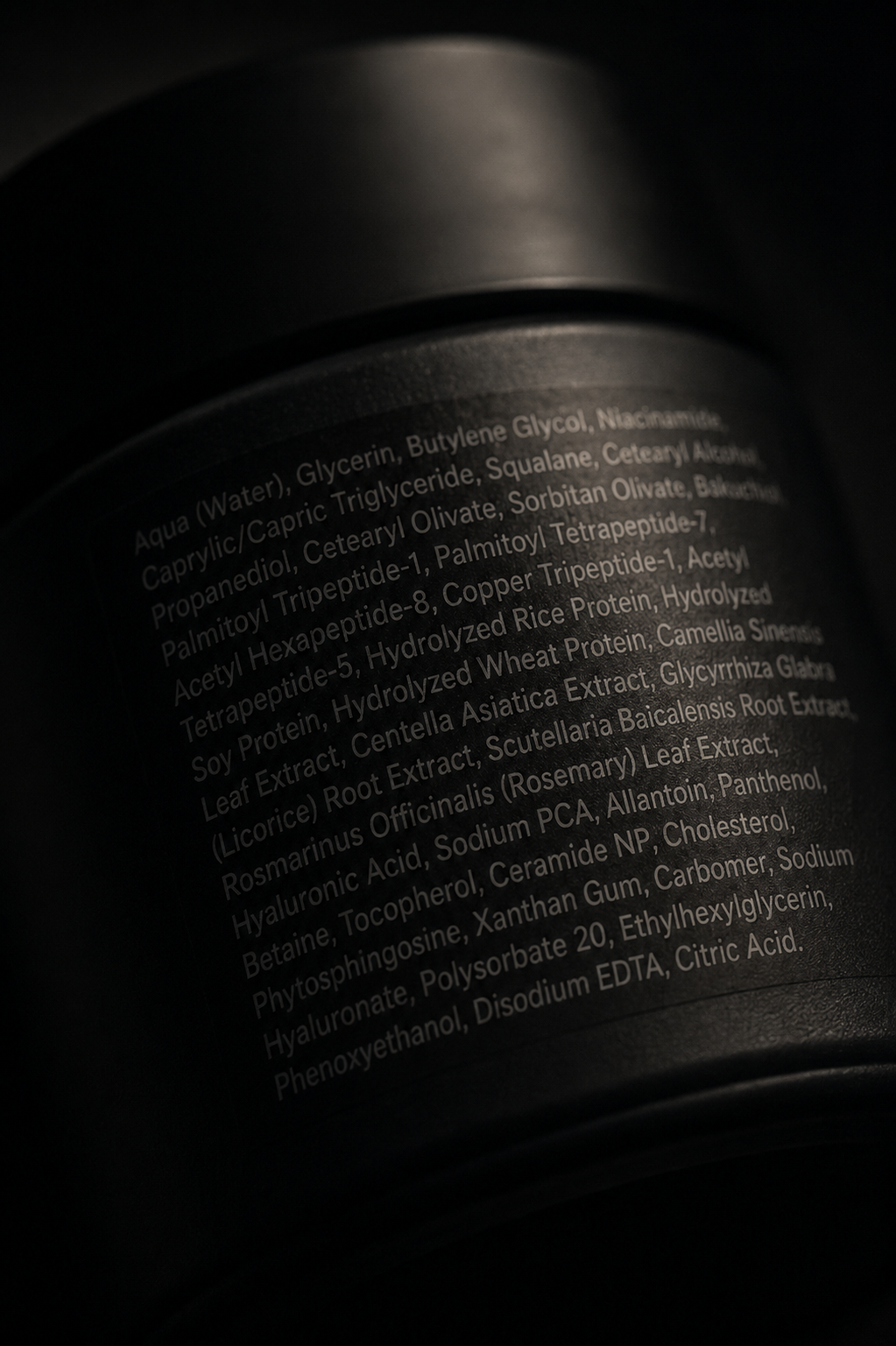
Peptide names on INCI lists look like someone fell asleep on a keyboard. Here's a cheat sheet:
Palmitoyl + [anything]: The "palmitoyl" prefix means a fatty acid has been attached to the peptide to help it get through the skin barrier. Essentially, it’s a delivery upgrade. Common in signal peptides.
Acetyl Hexapeptide: This is the Argireline family — the liquid Botox category we covered earlier. Acetyl Hexapeptide-3 is the most studied.
GHK-Cu or Copper Tripeptide-1: The carrier peptide you've probably seen everywhere lately. Strong clinical track record for skin repair and resilience. The hype is mostly earned.
Tripeptide, Tetrapeptide, Pentapeptide: The number tells you how many amino acids are in the chain. Longer isn't better — it just determines what it does.
Concentration: Peptides are expensive. If they're listed after the preservatives or fragrance, the concentration is likely too low to do anything meaningful. Effective doses vary by peptide — but if it's at the bottom, the odds go up that it’s just decoration.
How to use peptides effectively
Peptides are not instant-gratification ingredients. They work on the skin's timeline — which means consistent use over weeks and months, not days. If you're the type to abandon a product after two weeks because you don't see results, peptides will test your patience. Try to stick with them anyway.
Application: Peptides work best on clean skin where they can do their thing without competing with heavy occlusives or barrier-blocking actives. In plain terms: apply peptides before your heaviest moisturizer or SPF, not after.
Layering: Most peptides are compatible with humectants, barrier-support ingredients, and antioxidants — hyaluronic acid, glycerin, niacinamide, vitamin E, panthenol, squalane, ceramides. They don't play well with strong acids though — think AHAs, BHAs, and low-pH vitamin C. The acidity can break down peptide bonds before they even reach the skin. None of those have to be dropped— just used at a different time of day.
Frequency: Daily use is the way to go for most peptide-containing formulas. Consistency matters more than concentration.
Timeframe: Visible results from signal and enzyme-inhibiting peptides typically emerge at 4–12 weeks of consistent use. Carrier peptides may show results in wound-healing contexts more quickly. Set an alert on your calendar and withhold judgment until it pops up.
Pairing: Peptides and niacinamide are super compatible — both support barrier function and work together well. Peptides and retinoids can be layered but are best used at different times of day to reduce potential for interrupting peptide signaling.
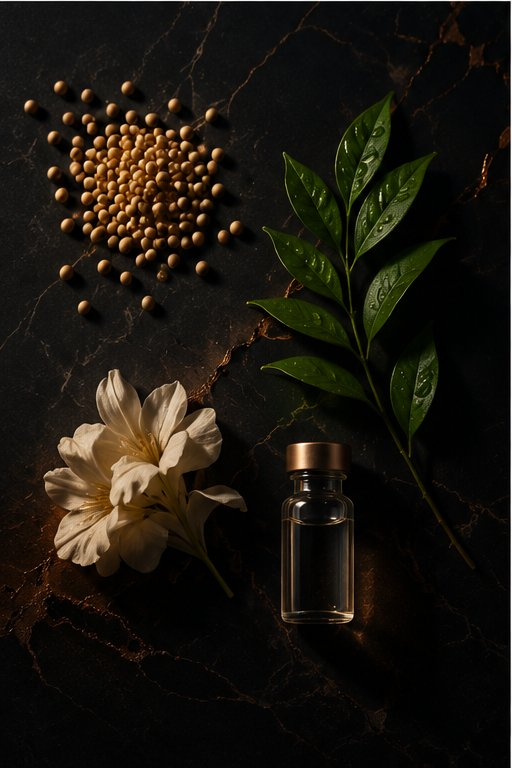
The Gladiateur Peptide Complex™
We don't use pre-made peptide blends. The market is full of them — designed for cost efficiency and broad-spectrum marketing claims rather than formulation specificity. Every supplier solution we evaluated came with carriers we don't use, synthetic solvents, or ingredients that contradict everything we stand for. So we built our own.
The Gladiateur Peptide Complex™ works on three levels simultaneously — because addressing skin renewal at only one biological level is how you get a formula with peptides in it rather than a peptide formula.
The scaffold. A trio of plant proteins — each contributing a distinct amino acid profile — that creates the environment for renewal. Together they form a more complete protein matrix than any single source provides.
The remodel trigger. A clinically studied botanical active chosen for its documented ability to stimulate the biological response that drives overnight skin remodeling. Not chosen for its trend status. Chosen because the data holds up.
The signal. A biotech peptide that operates at the cellular level to support skin renewal and resilience through direct signaling — something plant-derived ingredients alone cannot replicate. This is the ingredient that elevates the complex from a botanical support system to a genuine peptide complex.
It isn't natural for its own sake. It isn't synthetic for performance's sake. It's the most honest version of what a renewal complex can be.
Where you'll see it first
The Gladiateur Peptide Complex™ is the active core of Nightwatch™ — our overnight recovery cream, currently in development. The formula is built around the complex: delivery vehicle, pH, and surrounding ingredients were all selected to support peptide stability and penetration. That's the difference between a peptide formula and a formula with peptides in it.
The takeaway
Peptides are not mythical. They're not magic. They're one of the most well-researched classes of skincare actives available — with a mechanism that's understood, a clinical record that holds up, and a tolerance profile that makes them accessible to skin types that can't handle more aggressive interventions.
They work on the skin's timeline. They reward consistency. And in the right formula, with the right delivery system and the right supporting ingredients, they do something genuinely useful — quietly, reliably, and without drama.
Peptides aren't magic. They're mastery.
Explore further
Nightwatch™ — Product Overview (coming soon)
Glossary — Peptide, Collagen, Fibroblast, Signal Peptide
Part of The Library — Gladiateur Beauty™'s evidence-based skincare education and reference archive.